
Find People Across Washington
Begin with the fact that best separates one person from another. A full name can go into the Washington Courts participant search, a professional license lookup, the Corporations and Charities Filing System, or the Department of Corrections search. An old street address belongs in the assessor and GIS tools for the county where the land sits. A past school, employer agency, or town may point instead to a staff list, yearbook, city directory, or local newspaper.
Washington has no single resident roll. Its 39 counties keep deeds, tax rolls, marriage records, and superior-court files through separate auditors, assessors, treasurers, and clerks. Use a statewide result to identify a county, court, agency, or record number. Then move to the custodian that holds the source file. Keep spelling variants, married names, initials, and former counties in view because indexes reflect the names used when each record was made.
- Search statewide court, license, business, archive, and custody indexes with the name and any known variant.
- Capture the county, agency, case number, parcel, entity, or document number attached to a likely match.
- Open the relevant county assessor, auditor, treasurer, clerk, or city records system for the source detail.
- Use directories, newspapers, probate files, and historical vital indexes to test family and address links.
- Ask the proper custodian for an identifiable record when the index or image is not online.
Official indexes are leads, not proof by themselves. Compare two or more stable details before treating a result as the same person.
A phone number or email address is less useful in most official systems. Search it first in records you already control, saved messages, and lawful public sources, then connect any place or organization back to an official index. For a name shared by many people, narrow by middle initial, age range, county, business, profession, or known relative. Save citations as you work. A record title, custodian, date, and identifier make it possible to repeat the search and correct a false match.
Washington People Records Offices
State agencies hold vital certificates, business filings, archives, licenses, voter administration, and state custody data. Local offices hold much of the detail. County auditors record deeds and marriage returns. County clerks keep superior-court files, while assessors connect owners and mailing addresses to parcels. City clerks and records officers hold municipal files. The full access rules and request process belong with Washington public records.
Choose the office by who created the record, not by which office is closest. An auditor can locate a recorded deed but cannot certify a superior-court docket. A clerk can copy a divorce decree but does not issue the state certificate abstract. The assessor's current roll may identify a taxpayer, while the treasurer holds payment and delinquency data. Older local files may have moved to a county archive or one of the State Archives regional branches even though the originating agency remains the legal custodian.
Washington State Archives
Digital Archives and regional branches
Cheney, WA
Collection-specific help
Washington Secretary of State
Corporations and Charities Division
Olympia, WA
Online statewide access
Search Washington Statewide Indexes
Five statewide systems make a strong first screen. Washington Courts lists public case pointers. CCFS reveals entities, registered agents, governors, addresses, status, and filing history. Department-specific license tools show credentials and status. DOC lists people currently in state custody. Digital Archives searches historical collections by record series. None replaces the local source file, but each can supply the place or identifier needed for the next step.
| Washington lookup | Useful keys | What it can establish |
|---|---|---|
| Courts Case Records | Participant, case, court date | Court, case number, public parties |
| CCFS | Business name, UBI, agent | Entity status, filings, people tied to an entity |
| License systems | Name, license number, type, place | Credential status and issuing agency |
| DOC search | DOC number, first and last name | Current state custody and location |
| Digital Archives | Name, collection, county, date | Historic index entries and available images |
The Corporations and Charities Filing System accepts a basic business name or UBI and offers advanced filters for match type, status, and dates.
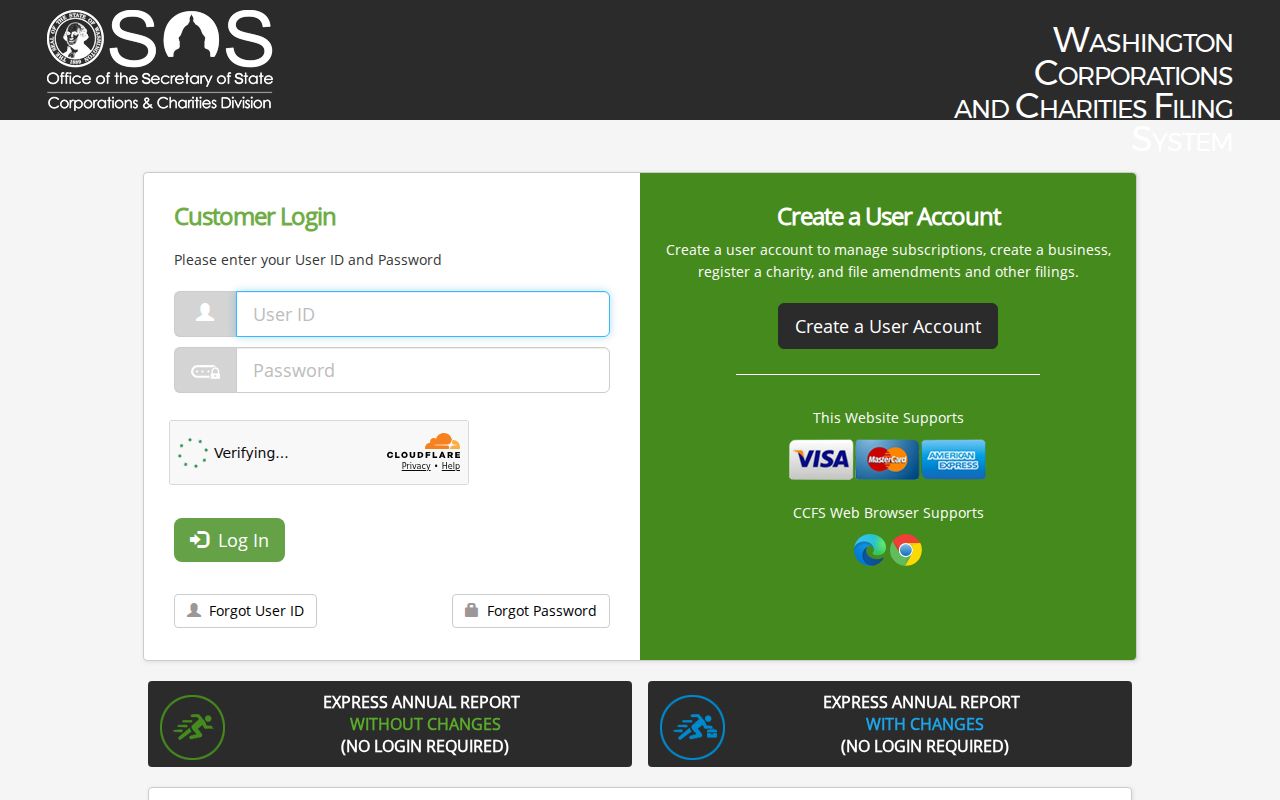
Its filing record can distinguish a business connection from a residential address and point older inactive entities to the Digital Archives.
Unclaimed property adds another statewide trail. Washington's Department of Revenue search accepts individual, business, maiden, partial, and similar names. It covers abandoned accounts, checks, securities, and safe-deposit contents, not land or vehicles. A match shows that property was reported under a name and address, but the state claim process controls proof of ownership. Use the free official portal and be cautious of anyone charging merely to reveal a result available from the state.
Trace Washington Property Records
An address trail starts with jurisdiction. A postal city can differ from the city or unincorporated county that governs the parcel. Find the county GIS or assessor record, then note the owner, taxpayer mailing address, situs address, parcel number, legal description, and relevant districts. Situs means the land's physical address. The mailing address is where tax notices go, and it may belong to an owner who lives elsewhere.
Next, carry the owner name, parcel number, or recording number into the county auditor's deed index. King County illustrates the limits: Landmark indexes records from 1976 forward, while most online images begin August 1, 1991. Its 1853 through 1975 grantor and grantee index remains on microfilm at King County Archives. Grantor is the party giving an interest; grantee is the party receiving it.
- Parcel
- A county-created identifier for one tax lot.
- Situs address
- The physical location listed on the assessment roll.
- Legal description
- The land description used in deeds, plats, or surveys.
- Instrument number
- The unique number assigned when a document is recorded.
Owner and occupant are not synonyms. Use city directories, phone books, census schedules, permits, and newspapers when the person may have rented or lived with an owner.
King County's parcel workflow also shows why search fields need care. Parcel numbers were not indexed consistently in recordings until about 2002, so older work needs grantor or grantee names and a recording-date range. A parcel report may link to surveys for an entire quarter section rather than the exact lot. Compare the legal description before accepting a survey. If a street name changed, a plat or section-township-range description can bridge the old address to the current parcel.
For a prior owner, start with the current vesting deed and work backward through each transfer. For a later owner, begin with the older deed and move forward. Liens, releases, plats, and short plats can add names but do not always show an ownership transfer. When a web image is missing, record the instrument number and request the image from the auditor or archive rather than guessing from the index line.
Search Washington Court Records
The Washington Courts Case Records Search is a statewide pointer for municipal, district, superior, and appellate matters. Search by participant name, case number, court date, or attorney bar number. A result can identify the court, case number, public parties, and docket path. The court of record still controls the official file, corrections, copies, and certification.
Odyssey supplies anonymous public case information for superior courts in 37 counties as of September 2025. It excludes King and Pierce superior courts and every court of limited jurisdiction. Anonymous users do not see documents. A county clerk may authorize broader access where its document manager is in use, while a lobby terminal may show more public information than the web.
| Court | Covers | Name Search | Access |
|---|---|---|---|
| Superior courts | Civil, felony, probate, family | Odyssey in 37 counties; separate King and Pierce systems | Index online; file from county clerk |
| Municipal and district | Limited-jurisdiction matters | State Case Records Search | Court counter or request for full file |
| State appellate | Appeals and Supreme Court | Case Search and document portal | Recent public documents free by case number |
| Federal districts | Federal and bankruptcy cases | PACER | Federal docket access and clerk fallback |
Sealed cases, adoption records, many juvenile matters, and confidential identifiers will not appear in full. A missing result does not prove that no case existed.
The official Washington Courts entry point shows where statewide searches begin.
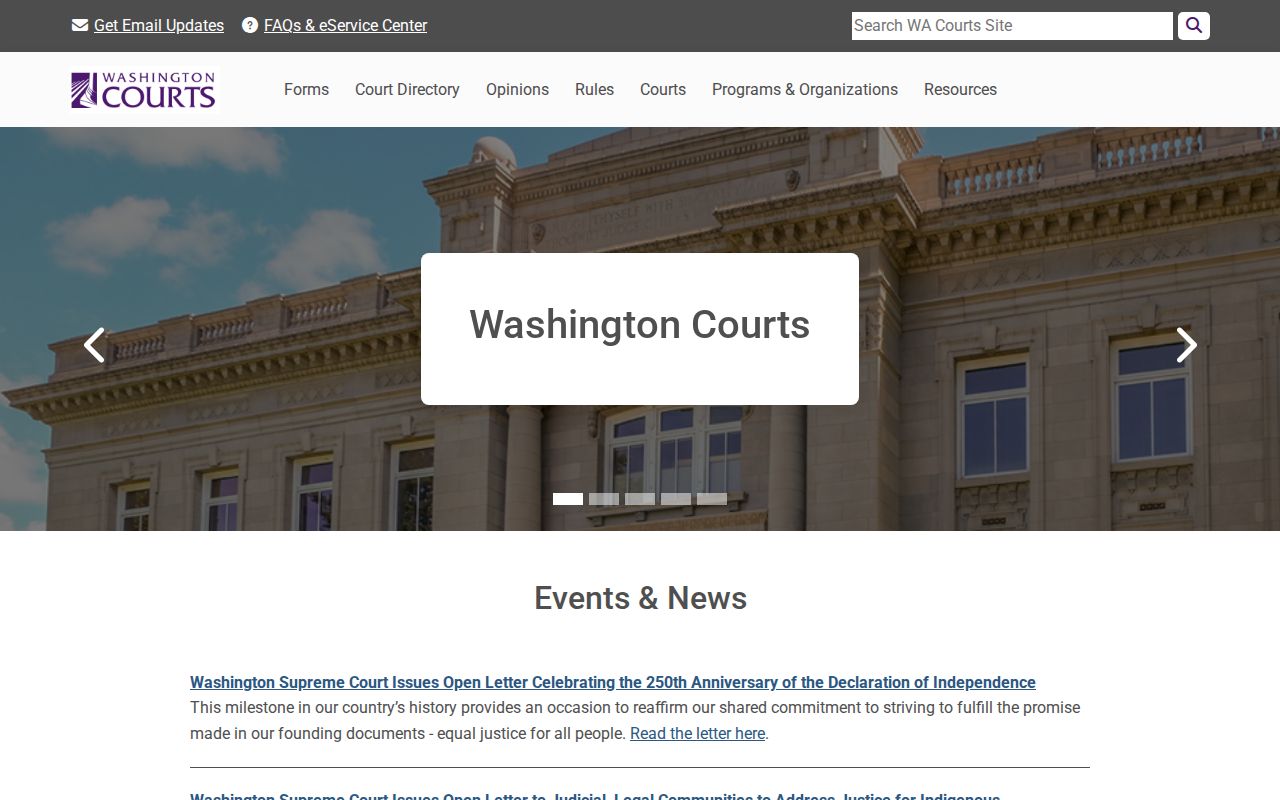
Save the court and case number together because the clerk needs both to retrieve the authoritative record.
Read a court hit by level and case type. Probate files can identify a decedent, heirs, creditors, and a personal representative. Civil captions show named parties but not necessarily the facts behind the dispute. Criminal results may change after vacation, sealing, or correction. JIS-Link offers registered display-only docket access across court levels for a per-command fee, but it has no filed-document images. For appellate cases filed after January 1, 2020, the public document portal can supply unsealed opinions and filings when the case number is known.
Check Federal Washington Cases
Federal records follow a separate path. The Western and Eastern Districts of Washington use PACER for party-name and case-number searches, as do federal bankruptcy courts. County determines the correct district. The index and docket may show parties, filings, counsel, and disposition, but document fees and federal access rules apply. A federal clerk's office remains the offline option when an online search is unclear.
Open the official PACER search entry point only after testing name forms and estimating the likely district.
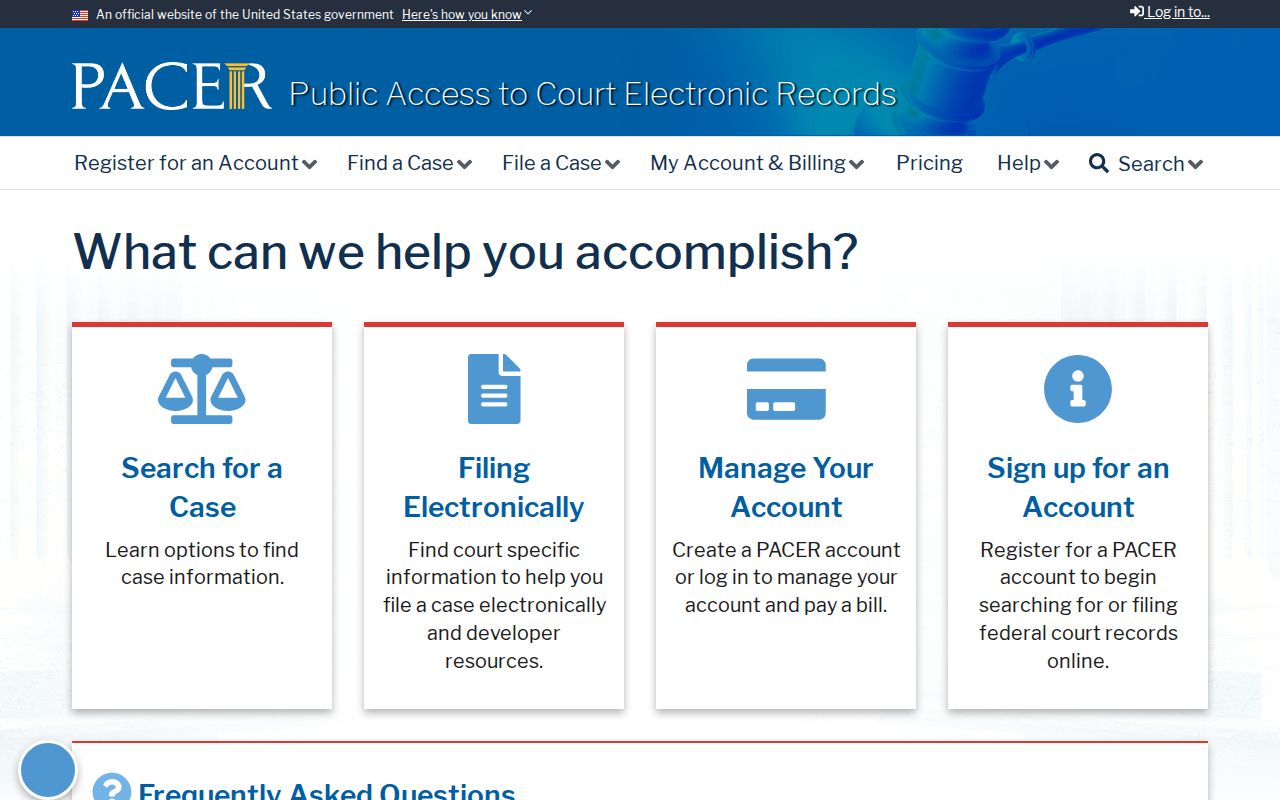
A docket is the dated list of case events and filings. It can provide the sequence needed to ask the court for a specific public document.
Locate Washington Vital Records
Washington Department of Health issues certified birth, death, stillbirth, marriage, and divorce certificates. Current vital records are confidential under RCW 70.58A.540 and are not a free name-search database. Birth and death certificates require a qualified applicant for certified copies, though informational copies have a different route. Marriage and divorce certificates do not use the same relationship gate.
County health jurisdictions issue many recent birth and death certificates. County auditors hold marriage applications and returns, while superior-court clerks hold divorce case files and decrees. DOH marriage and divorce abstracts cover 1968 forward. Historical births transfer after 100 years, while deaths, marriages, and divorces transfer after 25 years for State Archives access.
The Washington vital-records office lists certificate choices, proof rules, and order channels.
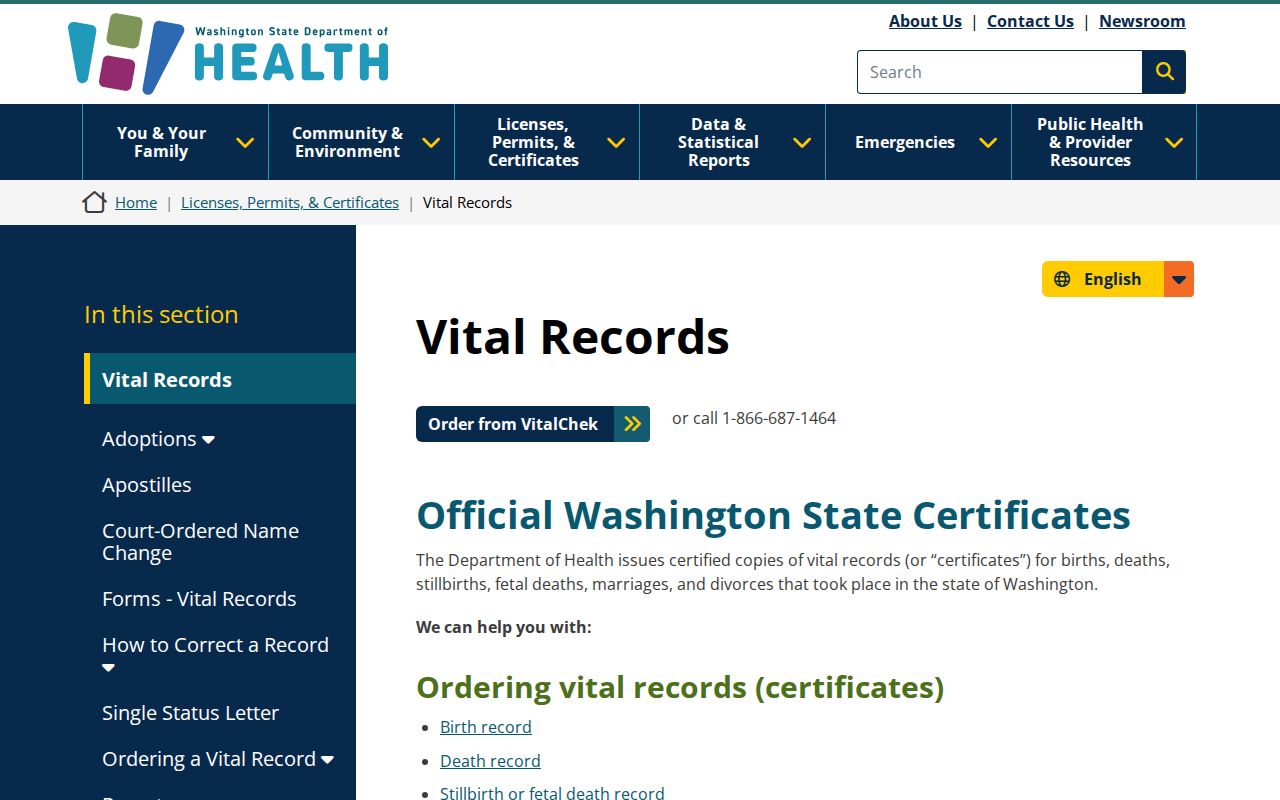
Use the event place and date to decide whether DOH, a local health office, an auditor, a clerk, or the Archives holds the useful record.
Ordering channels differ in cost and speed. Mail requests go directly to DOH with the form, identity material, relationship proof when required, and payment. Online and phone orders use the state's approved vendor and add vendor charges. Many local health jurisdictions offer recent birth and death certificates with their own covered years and fees. Informational copies can help family research, but they are not certified legal copies. No-record and failed-eligibility searches are not refunded, so verify the event facts and qualification before paying.
Marriage and divorce trails often split across three records. The DOH certificate is an abstract. The county auditor may hold the marriage application and return, and the superior-court clerk holds the divorce pleadings, orders, and decree. Historical indexes in Digital Archives may supply a name, county, and date that makes a later certificate or local-file request precise.
Explore Washington Digital Archives
The State Archives combines online and regional access. Its Digital Archives searches historical vital, land, court, census, naturalization, cemetery, and local-government series. Coverage depends on the collection. Choose the record series and county before assuming a statewide name search has searched everything. Physical records can remain at a regional branch or with the creating county.
The Washington Digital Archives presents its collections and name-search routes in one place.
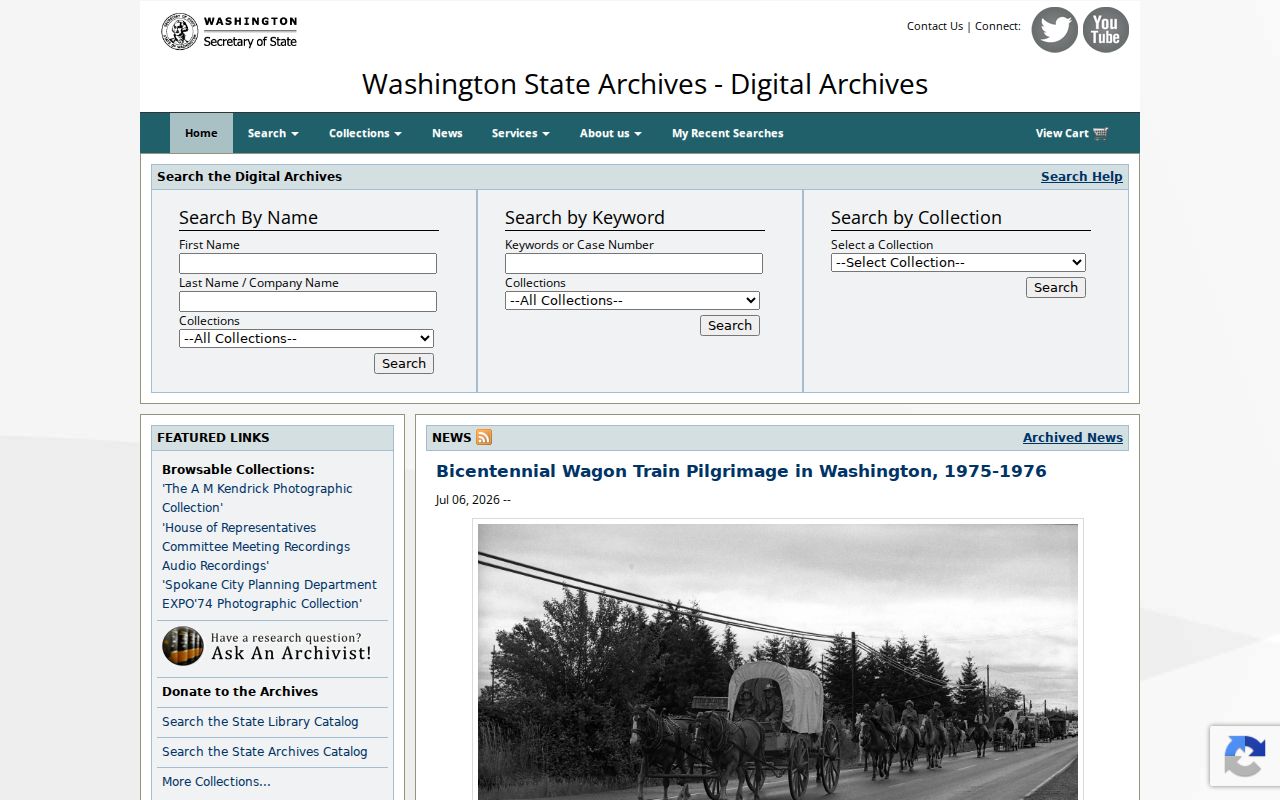
Collection titles, date spans, and county coverage matter as much as the name typed into the search form.
Search by record family rather than sending one name across every collection at once. Naturalization records, census records, marriage returns, cemetery files, court indexes, and institutional registers each answer a different question. Browse options can expose spelling or Soundex forms missed by exact search. If a digital index identifies a record without an image, follow the catalog note to the regional branch, county office, or research request channel. Statutory closures still apply after transfer to an archive.
Follow Washington Custody Records
The DOC Incarcerated Search covers people currently in state custody and certain contracted locations. It accepts DOC number, first name, and last name. Results display DOC number, name, age, current location, and a WA VINE notification route. Status changes fast, so verify it with DOC and use the sentencing court for the case file.
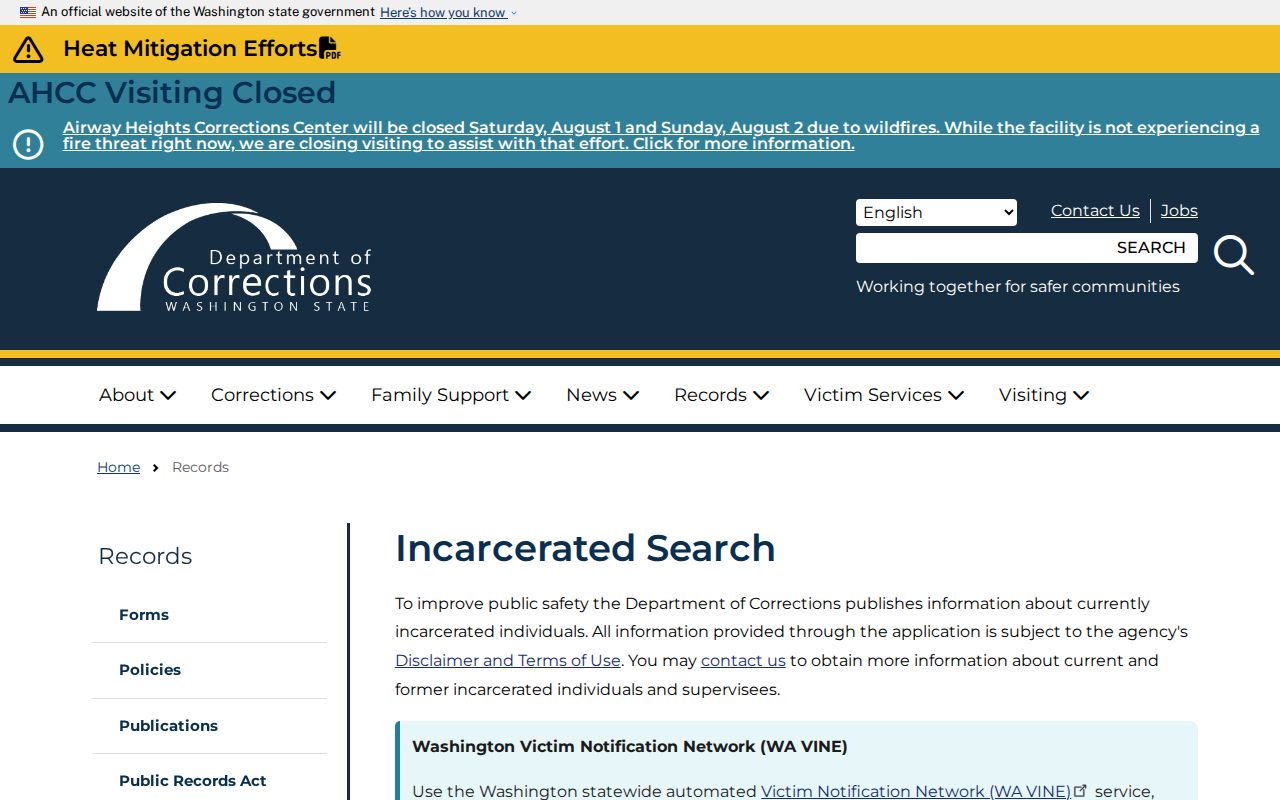
The state tool is not a county-jail history. For a local booking, identify the county and use its sheriff or corrections roster and records unit.
Washington's separate Secretary's Warrant Search can be searched or browsed by first name, last name, DOC number, crime, and county. It may display a warrant date, offense, county, photo, physical description, and supervision details. Treat that information as time-sensitive. A county jail roster covers local custody, while the federal Bureau of Prisons locator covers federal custody and releases in its stated range. Those systems do not substitute for the sentencing court's docket or the agency file.
Lawful use. Never contact a wanted person or use public information to track, threaten, or harass anyone. Call 911 for an immediate threat.
Use Washington Voter Tools Carefully
VoteWA is an identity-gated service for a voter checking a personal registration and ballot information. It asks for first name, last name, and date of birth. It is not an open browse-by-name directory. Washington also does not register voters by political party, so a missing party field is not missing data. Registration problems and county-specific questions go to the relevant county elections office, whose contacts are listed by the Secretary of State.
The statewide voter database extract follows a separate request process and strict statutory limits. Public fields do not include the full date of birth, signature, driver-license number, Social Security number, or a protected participant's confidential address. Use restrictions apply after release, and knowing misuse can bring criminal and civil consequences. Detailed fields, file delivery, history, and protection rules are covered with the Washington voter registration record.
Washington's Address Confidentiality Program provides a substitute address and mail forwarding for eligible survivors and certain threatened public workers. Protected voter handling uses a special process rather than ordinary online registration. The program can protect new public records when its requirements are met, but it does not erase every record created before enrollment. Call the program or follow its official participant instructions instead of testing a protected name across public tools.
Note: A VoteWA no-match can reflect spelling, a recent update, another county, inactive status, cancellation, or protected handling; ask the county before drawing a conclusion.
Reconnect Through Washington History
For a former classmate, distant relative, or past resident, current portals may be the wrong starting point. The State Library inventories city directories from 1890 to the present for 35 counties and about 300 cities. Local libraries add yearbooks, newspapers, obituary files, and cemetery sources. The State Library is no longer open for ordinary walk-in use; limited appointment access is available on Thursday afternoons.
Washington's geography and history can split a trail. County names changed, territorial files may predate statehood, and later counties inherited older records. Search predecessor counties, Oregon territorial material, federal records, and neighboring newspaper markets when a modern county search stops. The 1942 incarceration of Japanese Americans also broke many ordinary address trails, making federal and community archives vital for some families.
Probate dockets and obituaries can link a deceased person to heirs, but a shared surname is not enough. Compare dates, addresses, relationships, and the court file.
City directory runs are uneven. Seattle, Olympia, Tacoma, and Spokane have long but gapped holdings, and the State Library's inventory separately lists telephone books. Directories usually name adult residents, addresses, and occupations. Reverse or criss-cross volumes, where verified locally, work from address to occupant. Yearbooks connect names to schools and dates, while community oral histories can preserve relationships and migrations that never reached a government index.
Washington's labor and cultural archives add context without turning a collection mention into proof. UW collections preserve union records, oral histories, photographs, and community materials tied to Scandinavian American, African American, Japanese American, Jewish, Filipino, Asian American, and other communities. Search finding aids first, respect access limits, and cite the specific folder or interview that supports a connection.
Washington Frontier Justice Names
The Frontier Justice project rescued an unusual statewide trail. A 1984 federal grant supported two years of work on more than 37,000 territorial district-court cases from 1853 through 1889. Researchers indexed more than 130,000 names and subjects and microfilmed files. About 42 percent of the cases concerned debts and land disputes, while probate matters can identify heirs, property, and obligations.
Search the Frontier Justice guides with the understanding that territorial court districts and later county lines do not map neatly onto today's portals. Record the historical court, date, name form, and successor county before ordering a file.
Washington's Digital Archives opened in Cheney in 2004 as a purpose-built digital archive, but that date did not place every county book online. Recorder image dates and court migrations still vary by county.
Compare Official Washington Sources
Commercial compilations may combine phone, address, and public data, but records can be stale, merged, or assigned to the wrong person. Official sources answer narrower questions and show who keeps the underlying file. Use the compilation only as a lead, then confirm through the named court, county, agency, library, or archive.
| Source type | Best use | Main limit |
|---|---|---|
| Official current index | Case, license, custody, entity, or parcel status | Often omits the source document |
| County source file | Recorded image, case paper, assessment, or local return | Requires the correct county and custodian |
| Library or archive | Past addresses, relatives, occupations, and historical context | Coverage varies by place and year |
| Commercial compilation | Generating a possible lead | Accuracy and freshness are uncertain |
Note: A statewide portal seldom includes every Washington county image, so keep the counter, mail request, and regional archive in the fallback chain.