
Use Washington's VoteWA Lookup
VoteWA gives a registered voter access to their own account. It is not an open directory of Washington residents. A successful sign-in can reveal registration and ballot information, the correct county contact, a replacement-ballot option, voters' guide details, and voting or drop-box information. An unregistered person cannot enter an account. When more than one record matches, the voter selects the entry whose address matches. The login checks four inputs. Names must match the voter registration record, so a changed or shortened name may fail even when the person is registered. The date follows the month/day/year pattern. VoteWA also requires its anti-automation check.
| VoteWA field | Input | Required | How it works |
|---|---|---|---|
| First Name | Text | Yes | Must match the registered first name. |
| Last Name | Text | Yes | Must match the registered last name. |
| Date of Birth | Date or text | Yes | Enter in MM/DD/YYYY format. |
| reCAPTCHA response | Challenge | Yes in practice | Confirms a person is using the form. |
The sign-in button does not browse, export, or paginate voter rolls. A nonmatch sends a registered voter to their county elections office for help. Someone who is not registered receives the registration route instead.
The official VoteWA voter registration login shows the exact identity fields before sign-in.
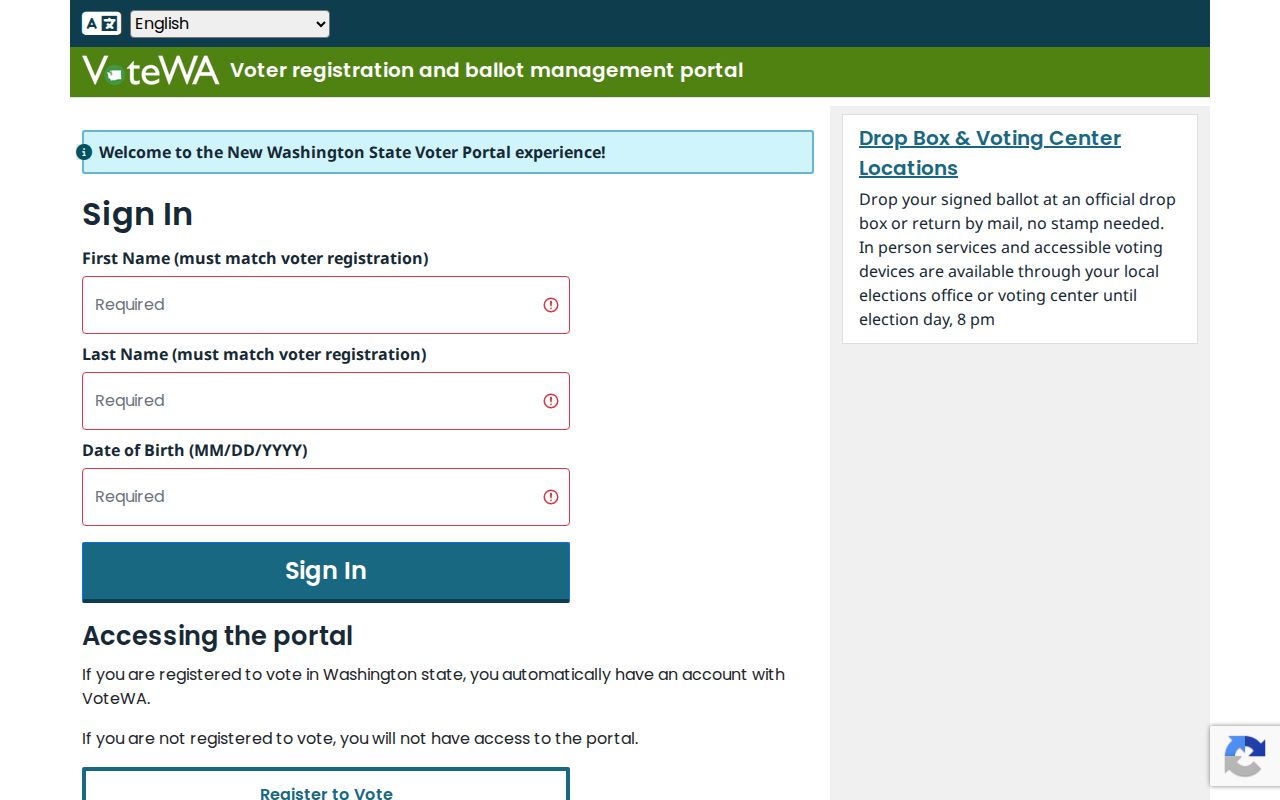
The form's narrow set of fields confirms why VoteWA is a personal account tool, not a public name search.
Washington Voter Records Custody
Washington divides voter registration work between the Secretary of State and all 39 county auditors. The Secretary of State maintains the centralized Washington Voter Registration Database, usually called the VRDB. County auditors retain original county records and carry out much of the local maintenance. The central system began in January 2006, replacing separate county lists that could include duplicate entries.
The Secretary of State's VRDB overview explains the statewide database. State staff coordinate comparisons with data from Licensing, Health, Corrections, and the Social Security Administration. Those checks support list quality, but a potential match is not treated as an automatic fact. Human review remains part of the process.
County geography still matters. Questions about a personal record, a name mismatch, an address update, or a local source document belong with the auditor for the county where the voter is registered. Statewide extract requests go to the Secretary of State.
Fields in Washington Voter Records
The government VRDB contains more than the public voter file. Under RCW 29A.08.125, the official database includes at least the voter's name, full date of birth, residence address, signature, gender, registration date, and unique voter identifier. Public disclosure is narrower.
The extract has 33 columns. It separates name parts, street components, districts, mailing fields, and registration data. This makes the file useful for lawful civic research without releasing every item held in the source system.
| Identity | State voter ID; first, middle, and last names; suffix; year of birth; and gender. |
|---|---|
| Registration address | Street number and fraction, street name and type, directional fields, unit, city, state, and ZIP code. |
| Districts | County, precinct and precinct part, legislative district, and congressional district codes. |
| Mailing address | Three address lines plus city, ZIP, state, and country. |
| Record activity | Registration date, last-voted field, and status code. |
| Voting history | Current and prior-year participation history, not any ballot choice. |
Washington keeps key fields confidential. Under RCW 29A.08.710 and related limits, original forms, full birth dates, signatures, driver or ID numbers, and Social Security number digits are not in the public extract. RCW 40.24.060 protects qualifying address-confidentiality records.
No Party on Washington Rolls
Washington does not register voters by political party. VoteWA does not display a party affiliation, and the public VRDB extract has no party field. That point prevents a common false inference from voter records.
Participation history is also limited. It can identify elections in which a ballot was credited, but it never reveals how someone voted. The secret ballot remains separate from the voter registration system. A “last voted” value or election-history entry proves participation recorded by election officials, not support for a person, measure, or party.
This distinction is especially important when comparing Washington with states that do record party enrollment. Importing that assumption can turn a valid row into a false profile.
Request Washington's Voter File
The Washington VRDB extract request accepts applications from any requester who agrees to the statutory limits. The form states no party or campaign-only gate. It delivers a delimited CSV file through an emailed link after approval. The data updates at the start of each month, normally by the end of the first business day. Most approvals are immediate, though fulfillment may take five business days.
- Enter the requester's first and last name, email, phone, street address, city, state, and ZIP code.
- Choose the information requested and the county scope when the form presents county options.
- Accept the agreement covering RCW 29A.08.720, RCW 29A.08.740, and RCW 42.56.070(8), then submit with the “I agree to the above” control.
- Watch the supplied email address for the approved download link.
No payment field or posted fee appears on the electronic request form. RCW 29A.08.720 still permits actual reproduction cost. Questions may go to elections@sos.wa.gov or 360-902-4194. For other identifiable Secretary of State records, use the agency's public records request channel. General access-law procedure belongs with the broader Washington public records system, while voter-file rules remain specific to election law.
Note: Keep the approval email and note the extract month, since voter status and address data can change after delivery.
County Voter Registration Help
County elections offices are the practical fallback when VoteWA rejects a matching voter, a local record needs correction, or a county-held original is required. The Secretary of State's county elections office directory covers every Washington county. Its filter uses a County dropdown and an Apply button.
Each result provides the office address, public hours, email, phone, fax, website, and election-results link. This route avoids treating one large county as the model for all Washington voter registration questions. Offices can differ in local contact details even though the VRDB is statewide.
The official county-contact tool shows the filter and the contact rows used to reach the correct auditor.
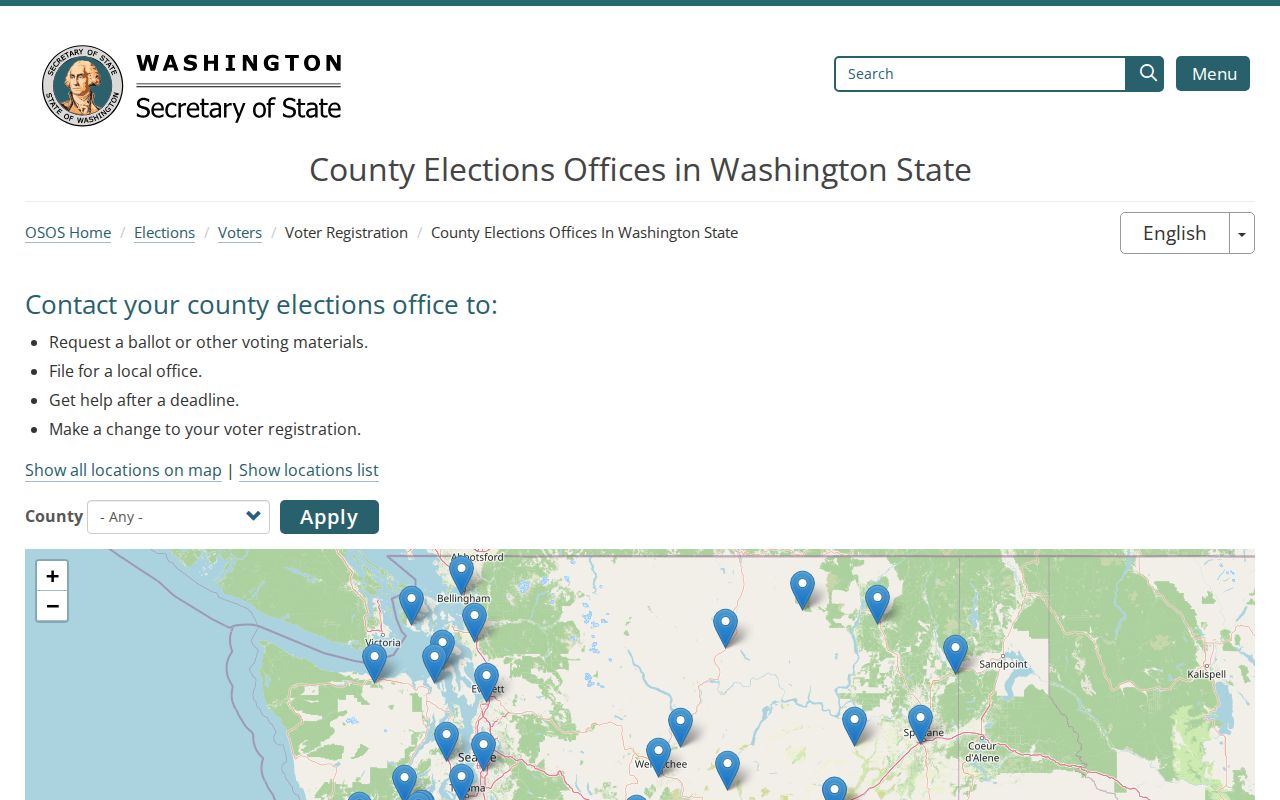
The detailed rows make phone, email, mail, and in-person help available when an online account does not resolve the issue.
Washington Elections Office
PO Box 40229
Olympia, WA 98504-0229
360-902-4180 or 1-800-448-4881
elections@sos.wa.gov
Monday through Friday, 8 a.m. to 5 p.m.
Secretary of State Records
PO Box 40224
Olympia, WA 98504-0224
360-704-5220
Fax: 360-704-7834
For identifiable nonstandard agency records.
Protected Washington Voter Registration
Washington's Address Confidentiality Program, or ACP, offers a special route for eligible participants. An ACP participant may become a Protected Records Voter. The person's actual residence, name, county, and precinct stay outside public voter records.
The process does not use ordinary VoteWA updates. Participants register through a special Protected Records Voter form handled with ACP and local elections officials. Later changes also route through ACP. The official ACP voter instructions explain that path, and participants can call 360-753-2972.
This protection affects both public extracts and local disclosure. A missing public address may reflect a lawful safety measure, not an incomplete search. Never try to reconstruct or publish a protected address.
Washington Voter Roll Status
Registration status can change without erasing the record at once. Returned undeliverable election mail moves a registration to inactive status. An address update, ballot request, or other registration activity can reactivate it. Failure to vote, by itself, does not cancel a Washington voter who still lives at the same address.
A voter who remains inactive through two consecutive federal general elections may be cancelled. Other grounds include the voter's request, a newer duplicate registration, death, a qualifying felony status, or a finding of ineligibility. Monthly death-data comparisons use information from Health and the Social Security Administration. Corrections matches generate notice and a 30-day window to dispute the match.
Washington strengthened challenge procedures effective June 11, 2026. The law added factual and burden requirements, required verification before cancellation based on a third-party death notice, and made a knowing challenge without reasonable cause a misdemeanor for each instance. Status codes should therefore be read as a point-in-time administrative state, not as proof of a person's present intent.
Limits on Washington Voter Lists
RCW 29A.08.720 makes current voter lists, precinct lists, and poll books public subject to confidentiality rules. It also bars using those lists for advertising or offers and solicitation for money, services, or anything of value. Political use is allowed under the statute.
Misuse has real consequences. RCW 29A.08.740 makes prohibited use a class C felony and provides statutory nuisance damages of five dollars per item, along with class-action, attorney-fee, due-care, and joint-liability provisions. Public access never permits tracking, threats, stalking, or harassment.
Use voter records lawfully. Request only data needed for a permitted purpose, follow the signed statutory agreement, and do not use a public list to target or harm anyone.
Historic Washington Voter Registers
Modern VRDB extracts are not the only route. The Washington State Archives Digital Archives holds selected older poll books and registration registers. Coverage depends on the collection and place, so historical research should use a named series rather than assume a complete statewide run.
The Olympia Register of Voters is a vivid example. It covers 1872 to 1874, 1877 to 1879, 1881 to 1886, and a few entries from 1889 to 1890. Its 77 pages include signatures and ward numbers. Women's signatures during territorial women's suffrage from 1883 through 1886 give the register unusual historical value.
The archive's search has last, first, and middle name fields, plus a Soundex checkbox for similar-sounding names. Researchers can search or browse the series.
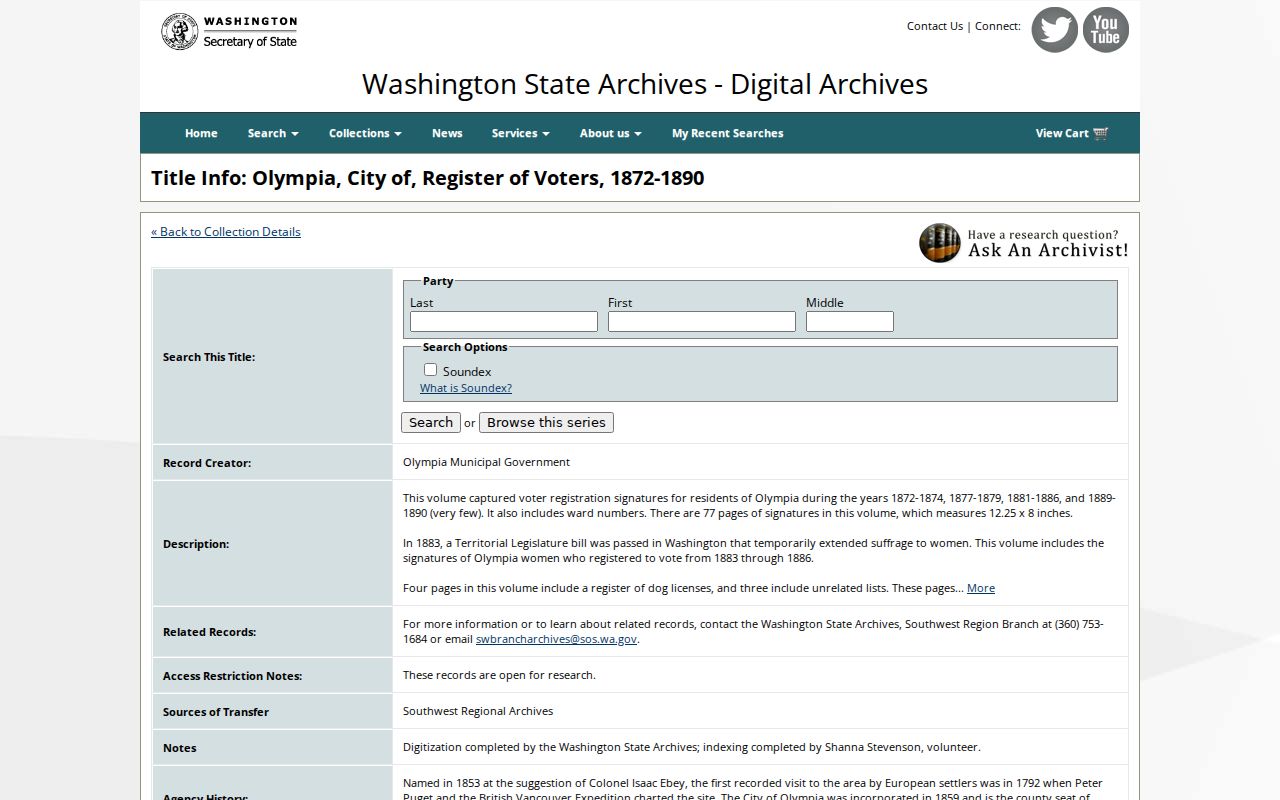
The Soundex option can catch spelling variants, while browsing may reveal entries that a strict name query misses. This register is Olympia-specific, not a substitute for every county's historic voter rolls.