
Washington People Directory Routes
Washington has no single resident list. Its useful people directories are a network of official rosters, institutional pages, county indexes, and historical collections. Each answers a narrow question. A staff directory identifies a public contact. An assessor roll names a taxpayer owner. A license tool confirms a credential. A city book can place an adult resident at an address decades ago.
| Listing source | People or names shown | Responsible keeper | How to use it |
|---|---|---|---|
| State Employee Contacts | State agency staff | WaTech and WA.gov | Free current web search |
| WSDOT Employee Directory | Transportation staff | WSDOT | Free web search, top 50 results |
| UW department directories | Faculty, staff, and some students | University of Washington | Free department pages |
| Assessment and recording indexes | Taxpayer owners and recorded parties | 39 county assessors and auditors | County portal, office, or archives |
| Professional and business lookups | Licensees, agents, and governors | State agencies and WSBA | Free official web tools |
| City and telephone books | Past adult residents, firms, and subscribers | Washington State Library | Onsite by limited appointment |
Choose by relationship, not just by name. State workers belong in agency tools, while faculty often appear in a department roster. For a property owner, start in the county of the parcel. For a past resident, use the town and approximate year to select a printed directory, newspaper run, or archive branch.
Washington Staff Directory Channels
The Washington State Employee Contacts directory accepts an optional last name, first name, or agency. It is the broad state roster, though its rendered search can require full browser support. The page is an agency contact tool, not a list of every Washington resident.
The fields are visible in the official state employee directory interface.
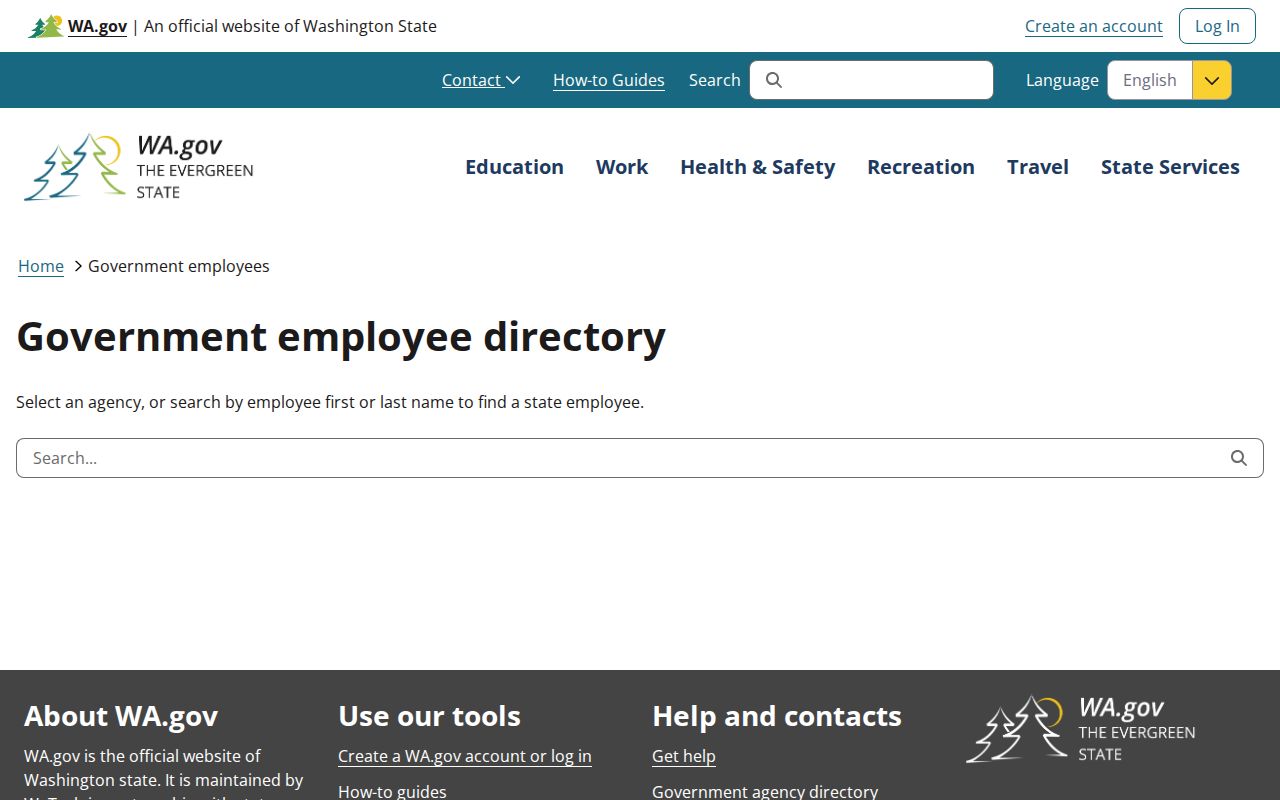
The three-field form lets a search move from a known agency to a named staff contact without relying on a general web result.
| Last name | Optional text field |
|---|---|
| First name | Optional text field |
| Agency | Optional selection or autocomplete |
| Search | Runs an agency or employee-name query |
City and county listings are not uniform. Seattle removed its failing citywide employee directory because of security and platform concerns. Its departments now use agency rosters or open data. The SDCI staff dataset is one example, with first and last name, title, phone, email, supervisor, work group, and department. If a name is absent, contact the agency main line, then the city clerk or local records officer for an identifiable public roster. General access rules belong with Washington public records.
WSDOT's Capped Washington Directory
The WSDOT employee directory is more detailed than the general state form. It accepts last name, first name, email address, city, and phone number. Initial characters and combinations work. Results report the name, phone number, city, and organizational code.
The official WSDOT search screen shows all five ways to narrow the roster.
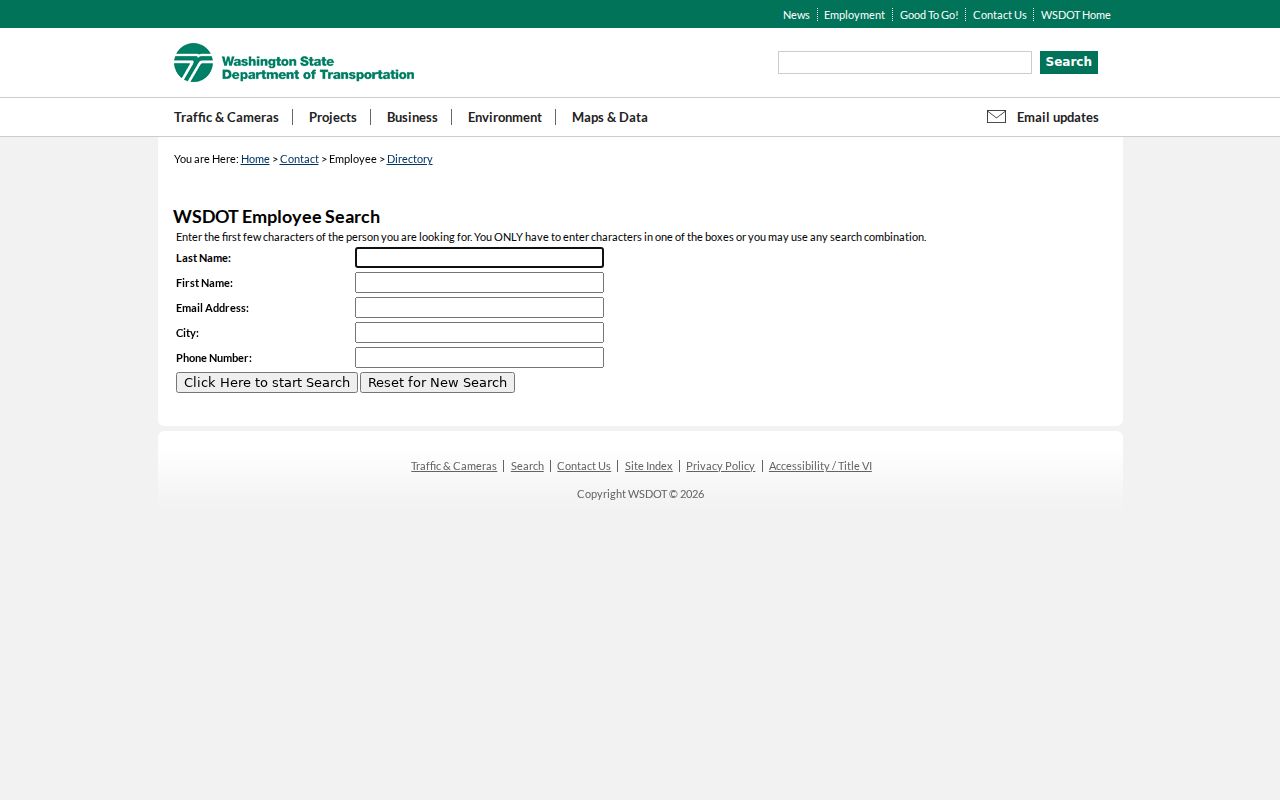
That extra detail matters because the directory displays only the first 50 matches. A blank query produced 7,259 matches when the source was inspected, so a broad surname may hide the person sought.
Washington University People Directories
University rosters work at the department level. The UW College of Education directory has a name-or-position text box, a select filter, and an Apply Filter control. Its entries show a name, position, email address, and profile link. A visible example in the research listed Lakeya Afolalu as an assistant professor with an institutional email and linked profile.
The captured UW directory screen pairs its filter with current faculty and staff entries.
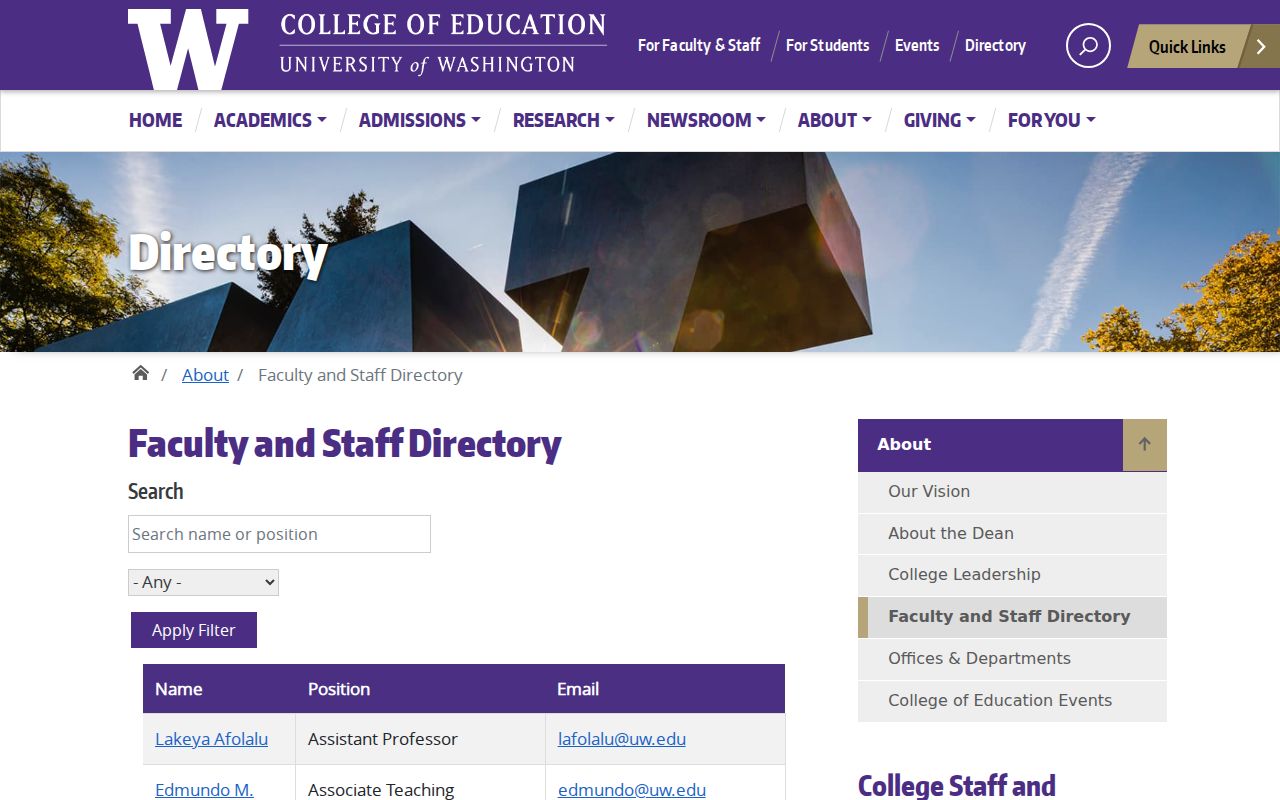
The listing connects a person to a role and unit, which is stronger evidence than a name alone. UW Physics adds name, status, field of interest, and A-to-Z browsing; entries may also show phone, office, and hours.
| Name | Person attached to the department |
|---|---|
| Position | Current academic or staff role |
| Institutional contact channel | |
| Profile | Department biography or research details |
K-12 search stays local. Seattle Public Schools publishes schools, addresses, and profile links, but not a district-wide person directory. No unified statewide K-12 roster was verified. Begin with the district and school, check its official staff page, and call the school office if the roster is incomplete.
Washington Owner Directory Layers
Property rolls are official owner directories, but Washington has 39 separate county systems. An assessor may show taxpayer name, mailing address, situs, parcel number, value, legal description, sale history, and a map link. Situs means the physical property location. The mailing address is where tax notices go, so it is not proof that the taxpayer lives at the parcel.
A county auditor's recording index supplies a second layer. It lists grantors, who transfer an interest, and grantees, who receive one. King County Landmark is a representative model: its web index begins in 1976, most images begin August 1, 1991, and the 1853 through 1975 grantor-grantee index remains on microfilm at King County Archives. Those dates do not describe other counties.
- Identify the county and search its assessor by owner, address, or parcel when those fields are available.
- Compare situs, mailing address, and legal description. Capture the parcel and recording numbers.
- Open the county auditor index by party name or instrument number. For older King records, use Archives microfilm or order the image.
Parcel IDs were not used consistently in King recording indexes until about 2002. Name, date, and legal-description searches are essential for earlier transfers. Office counters, county GIS, local archives, and a records request remain valid access channels when the web tool omits a field or image.
Note: A taxpayer owner and a current occupant may be different people, so pair the roll with directory or historical address evidence.
Washington License Directory Network
Official professional and business directories can distinguish people who share a name. The Department of Licensing lookup searches by name, license number, type, and location, then shows issued or active status and expiration. Some license types omit a street address, so a location-only query may fail.
The official DOL capture shows the name and license controls used for the search.
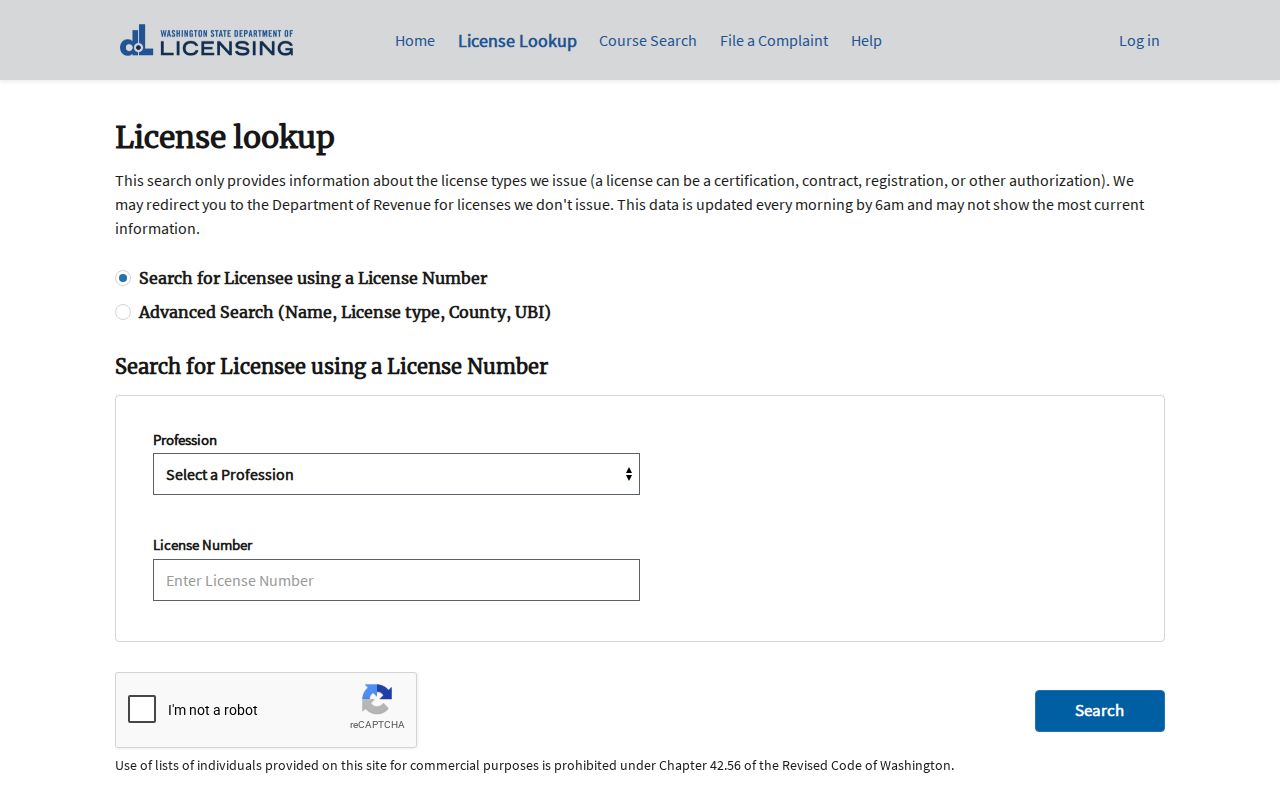
Search results should be matched by license type and current status, not by name alone.
Other Washington directory routes include the DOH Provider Credential Search for health credentials and discipline documents, L&I Verify for contractor registration, bond, insurance, and infractions, and the WSBA Legal Directory for legal professionals. The Corporations and Charities Filing System finds entities by business name or UBI and can expose registered agents, governors, addresses, status, and filing history. Washington's trade names register through the Department of Revenue, while UCC filings sit with DOL rather than the Secretary of State.
Historic Washington Directory Runs
The Washington State Library inventory maps directories from 1890 to the present across 35 counties and about 300 cities. Many runs were annual. Entries can name adult residents, occupations, businesses, addresses, and telephone subscribers. The books are onsite only.
The official State Library inventory records exact city and telephone-book years rather than implying complete statewide coverage.
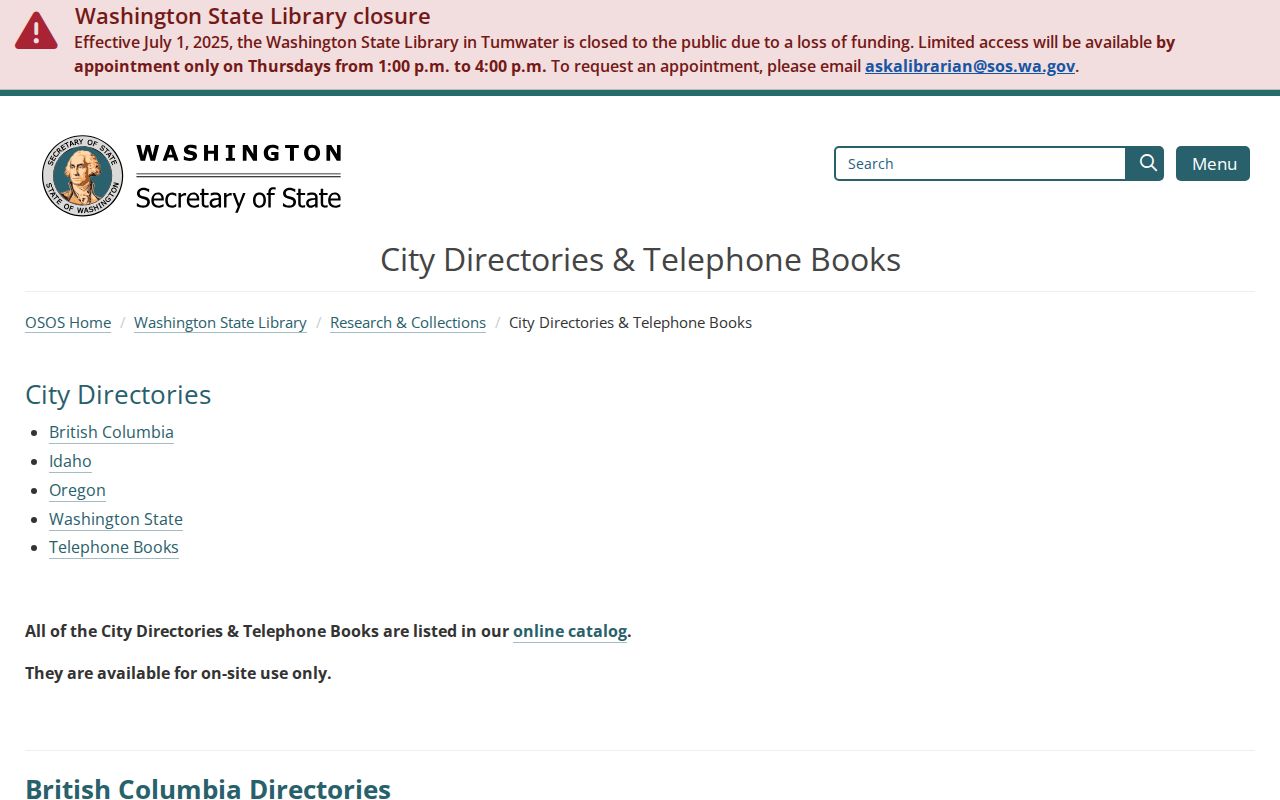
Its city runs include Seattle beginning in 1872, Olympia beginning in 1872, Tacoma beginning in 1882, and Spokane beginning in 1892. Years have gaps. The inventory separately identifies telephone books, but it does not verify exact reverse or criss-cross years. Never assume that every volume supports an address-to-occupant search.
- City directory
- A printed roster that may pair an adult resident with an address and occupation.
- Telephone book
- A subscriber list, often arranged by surname, that may omit people without listed service.
- Reverse directory
- A volume arranged by address or phone number. Availability must be checked for the place and year.
- Microfilm
- A photographed roll of pages read with library equipment when no digital copy exists.
Access changed on July 1, 2025, when the State Library closed to general walk-in use after funding loss. Limited appointments are offered Thursdays from 1 to 4 through askalibrarian@sos.wa.gov. Local public libraries and regional State Archives branches are additional channels for newspapers, school directories, and county-created records.
Washington Digital Archive Directories
The Washington Digital Archives search acts as a directory across selected births, deaths, marriages, divorces, censuses, cemeteries, institutions, land, military, naturalization, and family-history collections. Coverage depends on the record series. For example, the statewide death index covers 1907 through 2014 except 1960 through 1964. A regional or state branch is the fallback for missing years and undigitized files.
Territorial census sets are also uneven. County holdings run at intervals from about 1857 to 1892, while Digital Archives census material reaches 1847. Entries may include name, address, age, marital status, citizenship, nationality, and birthplace. Search name variants, married names, initials, and spelling errors.
Washington's printed and digital directory eras overlap. The Digital Archives facility opened in Cheney on October 4, 2004, but that date does not mean every county book or index went online. The State Archives still operates Olympia and regional branches at Bellevue, Bellingham, Cheney, Ellensburg, and Olympia.
Washington Community Directory Sources
Some people appear more clearly in community collections than in a modern government roster. UW's Labor Archives of Washington preserves union records, correspondence, rosters, and oral histories. Cannery Workers and Farm Laborers Union records also document Filipino and Asian American community life. Finding-aid limits still apply.
Many Paths, Many Voices brings together oral histories tied to Scandinavian American, African American, Japanese American, Jewish, arts, and North Cascades communities. Seattle Municipal Archives adds early tax lists, General Files from 1874 through 1905, directories from 1890 through 1990, and a Cemetery Removal and Reburial Register. That unusual register names people buried at the first municipal cemetery, now Denny Park, from 1861 through 1884 and identifies later burial places.
Community directories can be private or selective. No unified statewide alumni, chamber-member, union, congregation, or neighborhood person directory was found. Use an official finding aid, contact the holding archive, and respect access limits instead of treating a club or social roster as a public statewide index.
Limits of Washington People Directories
Directory evidence is a lead, not proof that two same-name entries describe one person. Dates, agency, city, role, parcel, and source should agree. Current rosters change. Assessor ownership can lag a filed deed. Historic volumes may skip a year or omit an adult, and telephone books include only listed subscribers.
Geography is just as important. Washington's county auditors, assessors, treasurers, clerks, and archive branches keep separate records. A statewide portal rarely supplies every underlying image. Tribal nations are sovereign governments, and state or county directories do not exhaust tribal records. Access must follow each nation's rules.
Commercial compilations may be stale or blend different people. Official Washington people directories show their keeper and purpose, making it easier to test a match and return to the source. When an online tool fails, use the agency main line, county counter, mail request, local library, or appropriate State Archives branch.