
Washington Records Open for Access
Washington divides record custody by both subject and level of government. County auditors record deeds, liens, plats, and marriage returns. County clerks retain superior-court files, including civil, criminal, probate, divorce, and guardianship matters. Assessors maintain valuation rolls, while treasurers keep tax accounts. State agencies publish selected indexes and issue state records. Access ranges from a free web index to an eligibility-gated certificate order.
| Washington record | Keeper | Web starting point | Access route |
|---|---|---|---|
| Deeds, liens, plats | County auditor | County-specific index | Web index, office, copy request, or archives |
| Court cases | Court or county clerk | Case Records Search; Odyssey for 37 superior courts | Index, clerk terminal, or file request |
| Parcel and tax rolls | County assessor and treasurer | County-specific portals | Web search, counter, or PRA request |
| Vital certificates | DOH, local health office, auditor, or clerk | Historical Digital Archives indexes | Qualified or informational copy; archive after transfer |
| Business and licenses | Secretary of State and licensing agencies | CCFS and agency lookups | Free search; agency request for added files |
| Custody records | DOC or county jail | State DOC and local rosters | Current lookup or custodian request |
Online entries are often pointers, not the official file. A court index does not replace a clerk-certified docket. A recorder index may show an instrument even when its image is offline. Sealed court material, many juvenile and adoption files, protected addresses, driver data, and current vital-record source files remain restricted under specific laws and court rules.
Washington Records Cross County Lines
Washington has 39 counties and no single statewide owner-name or recorded-document database. Start with the county where the property, filing, court case, or local event arose. An incorporated city's clerk or records officer handles city files. County systems take over for most land, tax, superior-court, and unincorporated-area files. A regional State Archives branch may hold an older series even though the creating county remains its legal custodian.
The portal label can mislead. “Statewide” may mean a broad index, not every image or source book. Puget Sound crossings, island counties, and county-line moves can put nearby events in separate systems. Tribal nations are sovereign governments, so state and county tools do not replace each nation's own access rules. This geography explains why a name-only query can miss a record that a county, date, and record-type search finds.
Note: Search the county tied to the event or file, not merely the person's current Washington city.
Washington Recorder Index Eras
King County offers a well-documented example, not statewide coverage. Its Recorder's Office search guidance says Landmark indexes recordings from 1976 forward. Most online images begin August 1, 1991. The 1853 through 1975 General Recordings grantor/grantee index remains on microfilm at King County Archives. A grantor transfers an interest; a grantee receives one.
The official King County page shows how access changes by era.
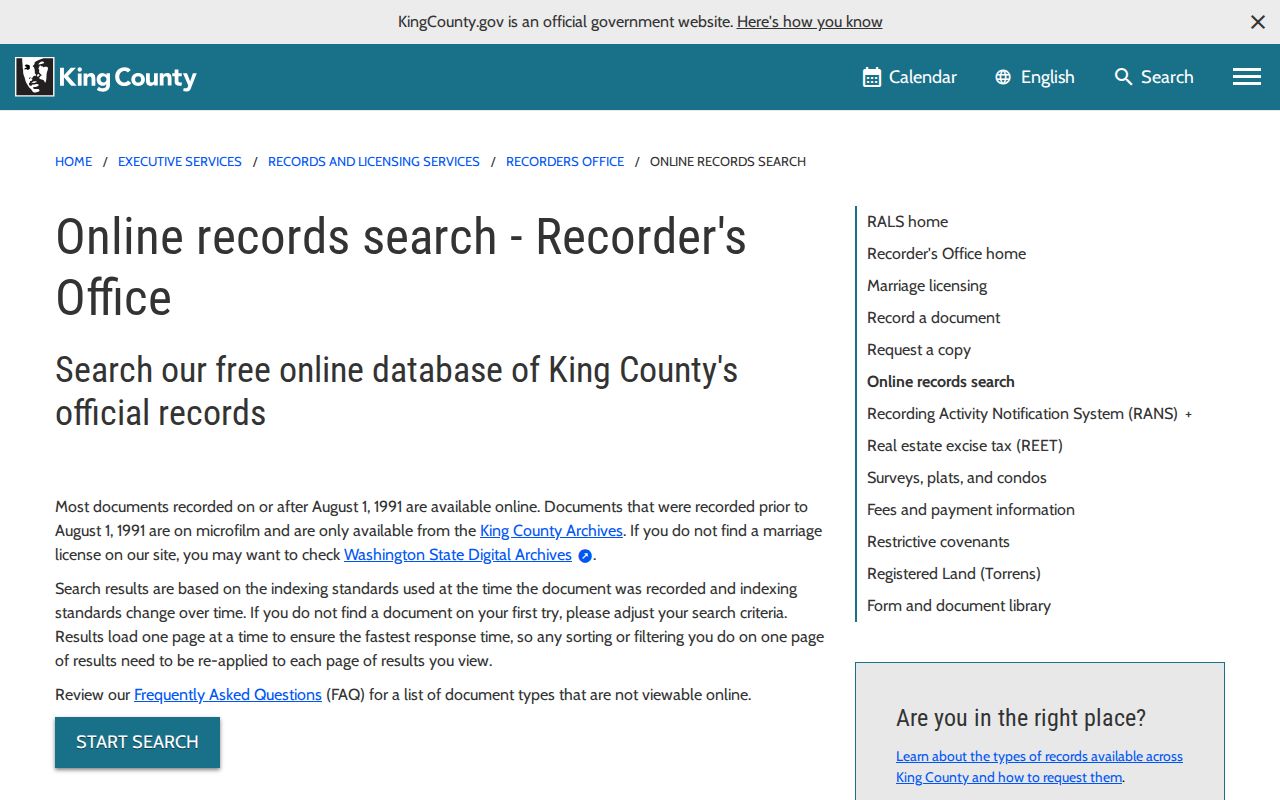
The page helps users choose the web index, paid copy channel, or archive fallback instead of assuming that every old image is online.
The Landmark search interface supports several routes. Historic indexing changed over time, so the county advises running variants and minimal name terms.
| Landmark field | Input | Use or limit |
|---|---|---|
| Name | Last, first | Required for name mode; try variants |
| Document type | Category selector | Limits deeds, plats, surveys, and more |
| Book and page | Text pair | Finds a known legacy citation |
| Parcel ID | Number | Not consistently indexed before about 2002 |
| Recording date | Date range | Index begins in 1976 |
| Recording number | Number | Most exact instrument locator |
| Legal description | Text | Useful for subdivision or land terms |
The live form puts those modes into a single search surface.
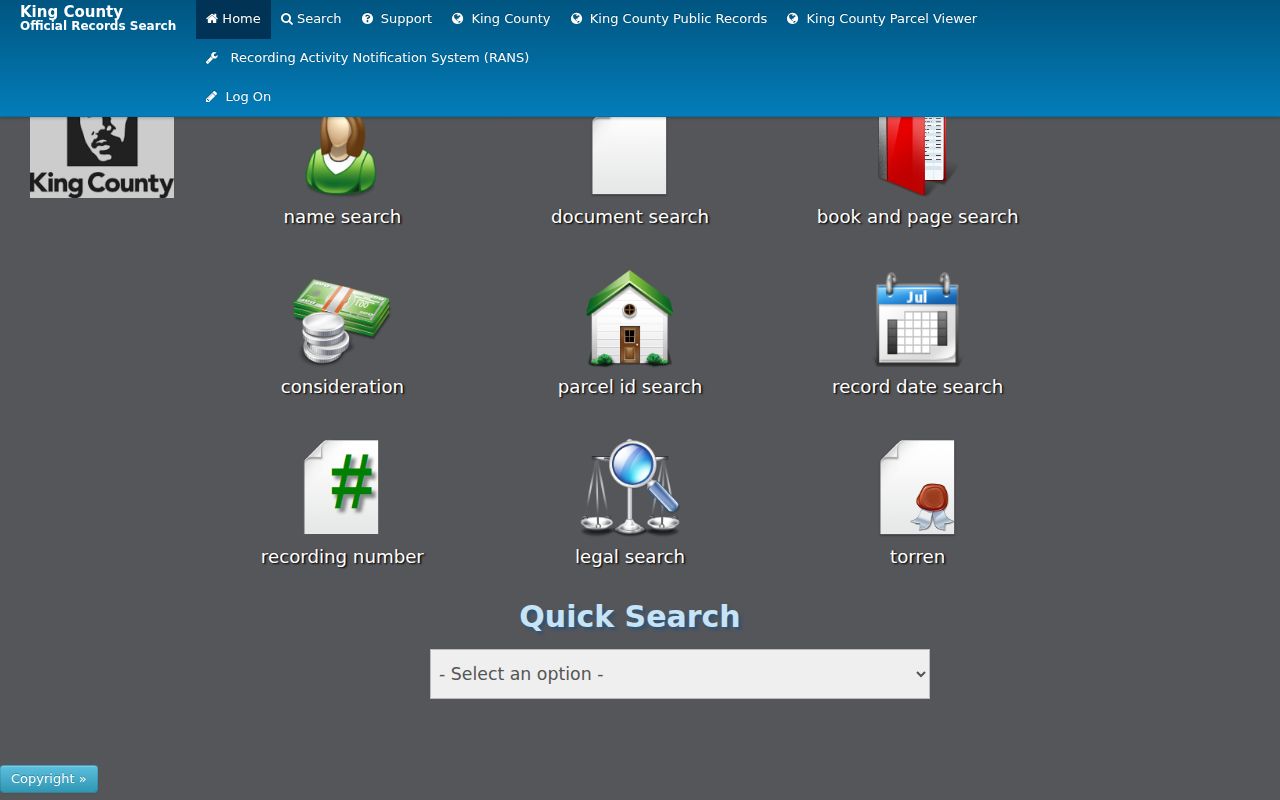
Results may include parties, roles, instrument number, recording date, type, book and page, parcel, short legal text, consideration, and image access. Watermarked recent images are free to view. Older images require an Archives order using the recording number.
Washington Court Records Boundaries
Washington Courts Case Records Search is the statewide pointer for municipal, district, superior, and appellate cases. It can search a participant name, case number, court date, or attorney bar number. The result identifies the court and case. The court of record supplies documents, corrections, and certifications. Court access follows rules such as GR 31 and GR 31.1 rather than the agency Public Records Act.
Odyssey covers superior courts in 37 counties as of September 30, 2025. It excludes King and Pierce, plus every municipal and district court. Anonymous users can view public case information but not documents. A county clerk may grant a registered role where Odyssey Document Manager is used, and county fees may apply. Lobby terminals can reveal more public material than anonymous web access.
The Odyssey Smart Search provides a court-location selector, search-type choices, party criteria, and case criteria.
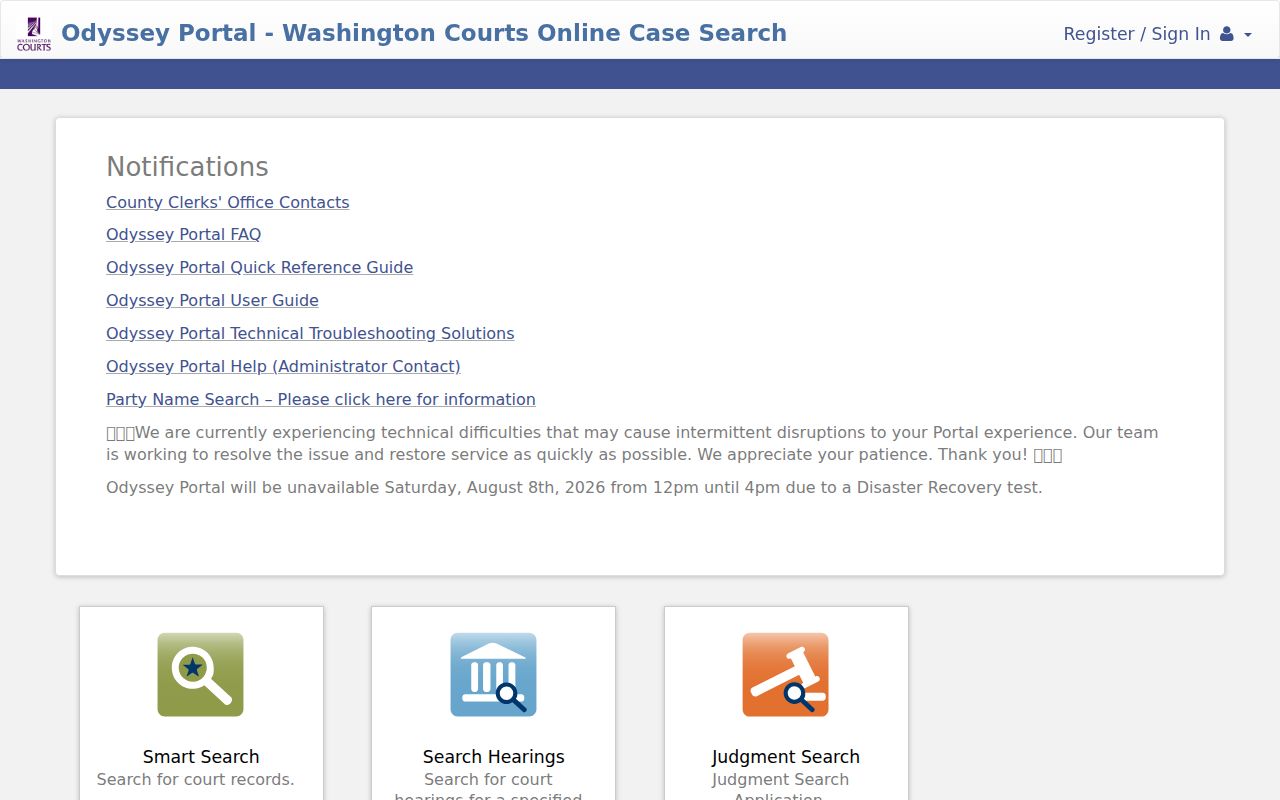
A result can show the case number, parties, type, location, filing date, events, hearings, judicial officer, and public status. JIS-Link is another registered, display-only route. It charges $0.145 per executed command and has docket entries but no filed-document images.
Portal comparison. Free anonymous Odyssey access shows case information. Clerk-authorized access may add documents and county copy fees.
Washington Property Record Custodians
Each county assessor controls its own assessment roll. Common fields include owner or taxpayer name, mailing address, situs address, parcel number, legal description, values, sale history, property traits, map link, and taxing districts. Situs means the location being assessed. A mailing address is where tax notices go. It may be out of state and does not prove where an owner lives.
County GIS viewers add boundaries and map layers, but Washington's Geospatial Open Data portal is not a consolidated ownership search. The auditor holds deeds and liens. The treasurer maintains bills, payments, delinquency, and foreclosure data. If a county web search omits owner names or older rolls, use the assessor counter or request an existing roll under the PRA. Auditor microfilm and archives remain the deed fallback.
A useful records chain is: county assessor roll, parcel and legal description, GIS map, auditor instrument index, then treasurer tax account. Ownership can lag while a new deed is being processed, so compare dates before drawing a conclusion.
Washington Vital Record Access
Washington Department of Health issues state birth, death, fetal-death, marriage, and divorce certificates. RCW 70.58A.540 exempts vital source records and supporting files from PRA inspection. Birth and fetal-death records transfer to historical access after 100 years. Death, marriage, and divorce records transfer after 25 years. The Washington Digital Archives then provides collection-specific historical access.
Current certified birth and death copies require a qualified applicant, identity proof, and relationship proof. Anyone may order a paid informational copy. Marriage and divorce certificates do not use the same relationship gate. DOH's marriage and divorce abstracts begin in 1968, while a county auditor retains the marriage return and a county clerk holds the divorce decree or full case.
The base certificate fee is $25. Mail orders use a signed form, ID copy, required proof, and check or money order, with a stated six-to-eight-week shipping period. DOH's approved vendor handles online and phone orders, starting at $40.50 before optional charges. Many local health jurisdictions offer birth and death certificates, sometimes the same day, but their covered years and added fees differ.
Washington Custody and Filing Records
The DOC Incarcerated Search covers people now in state custody and certain contracted sites. Search by DOC number, first name, or last name. Results show name, DOC number, age, current location, and a WA VINE notification route. It is not county-jail history. Local sheriff or corrections systems remain the source for county bookings.
DOC also publishes an outstanding Secretary's warrant search by first name, last name, DOC number, crime, or county. Its search and browse controls are shown on the official warrant page.
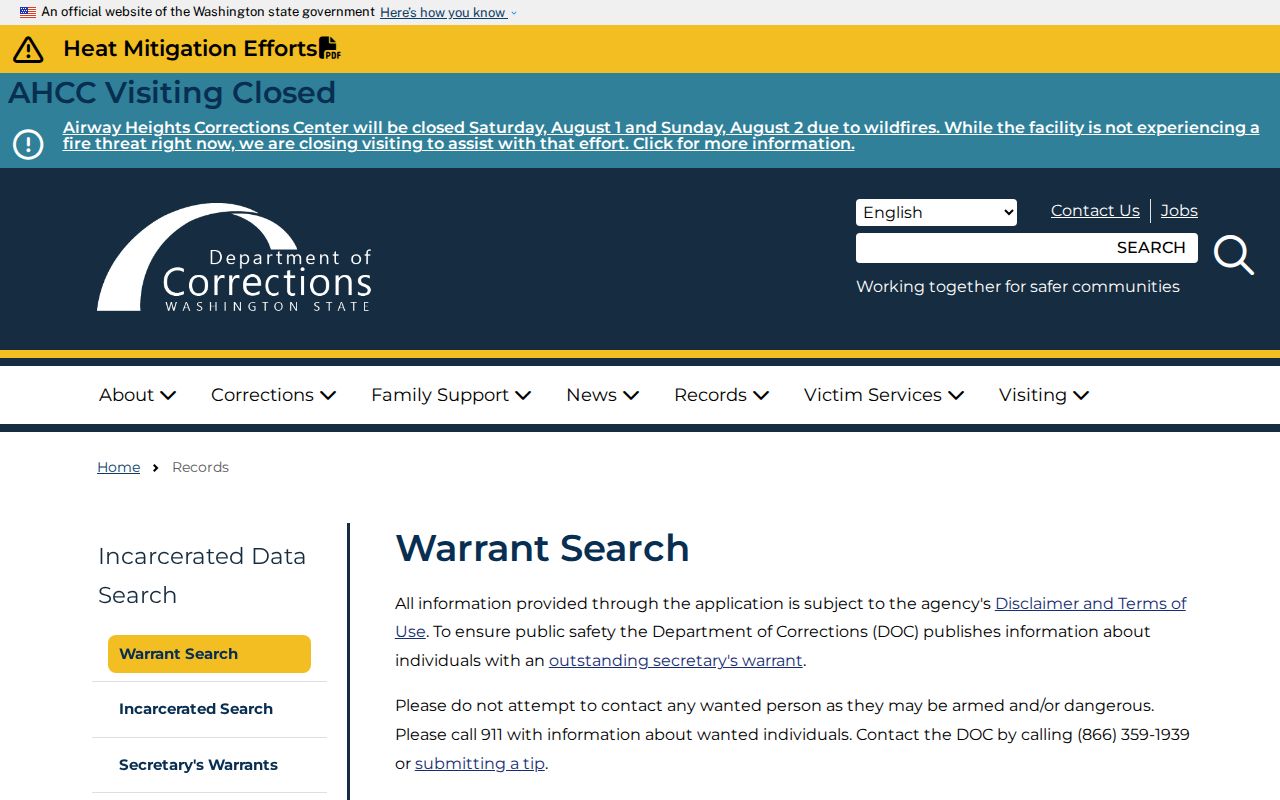
Expanded warrant entries can include the warrant date, crime, county, photo, physical details, and tip route. DOC warns users not to approach a wanted person. Status changes fast, so verify it with DOC.
For entity records, the Secretary of State's Corporations and Charities Filing System searches business name or UBI, with filters for status, type, dates, registered agent, and governors. Public, uncertified filing images are free. Inactive entities older than ten years route to the Digital Archives. Professional credentials are split among DOL, DOH, L&I, OSPI, and the State Bar.
Washington Public Records Gatekeepers
Custody determines the best contact. State portals are useful when the state created the file. County auditors, clerks, assessors, treasurers, and archives answer for local series. Asking the wrong office can delay access even when the requested record is open.
Washington State Archives
Digital collections, research requests, and regional archive fallbacks
Open Government Ombuds
Informal Public Records Act assistance
360-570-3418
AGOOmbuds@atg.wa.gov
A custodian is the agency or court that keeps and controls a record. Certification is the custodian's formal attestation that a copy is true. An index points to a filing, while an image reproduces its contents. An exemption is a law that permits or requires withholding all or part of a record.
- Index
- A searchable pointer with names, dates, numbers, or record type.
- Image
- A scanned or electronic view of the filed item.
- Certified copy
- An official copy authenticated by its keeper.
- Exemption
- A cited legal basis for withholding protected content.
Washington Records Copy Charges
Inspection under chapter 42.56 RCW is free. An agency may charge its actual copying cost. If that cost is unduly burdensome to calculate, RCW 42.56.120 permits default rates of $0.15 per photocopied or printed page, $0.10 per scanned page, $0.05 per four uploaded electronic files or attachments, and $0.10 per gigabyte sent electronically. Media, containers, and postage may be added.
Charges can be combined, or an agency may use a flat fee of up to $2 for a request. Routine downloads remain free. Customized electronic or data work can be billed at actual cost after an explanation, estimate, and chance to narrow the work. A deposit cannot exceed 10 percent. Agencies may bill installments as they are produced. Court, recorder, and certificate fees come from their own rules and schedules, so do not assume the PRA rate applies to every record system.
Note: Inspect first when possible, then buy only the pages or certified items needed for the Washington record trail.
Washington Records Kept Confidential
Open government has record-specific limits. Sealed cases and documents, many adoption and juvenile records, confidential protection-order details, and protected personal identifiers do not appear in ordinary court results. Driver personal data is restricted by federal and state law. Voter data has separate chapter 29A.08 limits. Recorded instruments and released agency files should have protected identifiers redacted where law requires it.
Washington's Address Confidentiality Program, created in 1991, was the first state program of its kind. Under chapter 40.24 RCW, qualifying survivors and other protected applicants can use a substitute address, receive forwarded first-class mail, and ask agencies to use that substitute in new public files. Real residence and other unique location details are confidential. A valid court order or properly signed law-enforcement request is required for release.
Current government records usually stay public unless a statute, court rule, order, or authorized redaction applies. A missing portal result can also reflect migration, old paper files, a spelling variant, or a nonindexed image. It does not prove that no record exists.
Request Washington Public Records
The Washington Public Records Act, chapter 42.56 RCW, applies to state and local agencies. Ask for an identifiable existing record. An agency need not answer a research question or create a new compilation. A requester generally need not explain a purpose, although an agency may inquire when a list of individuals is sought because the law bars providing such lists for a commercial purpose.
- Find the custodian. Identify the agency, county, court, record type, and likely date range. Courts use their own access rules.
- Check disclosed records. Search the official index or records library. Save any case, parcel, instrument, or file number.
- Describe the record. Submit the agency portal, email, mail, or in-person request with names, dates, numbers, and desired format.
- Track the response. Keep confirmation and answer a clarification request. Ask to inspect or narrow before paying for copies.
- Review withheld content. Request the cited exemption and explanation. Use internal review, Ombuds help, or court review when warranted.
Within five business days, the agency must provide the record or a specific online link, acknowledge the request with a reasonable estimate, seek clarification, or deny it. A denial must cite and briefly explain the exemption. Internal denial review must be prompt and is deemed complete after the second business day following denial.
The Secretary of State records-request instructions show a real Washington agency channel and its online portal.
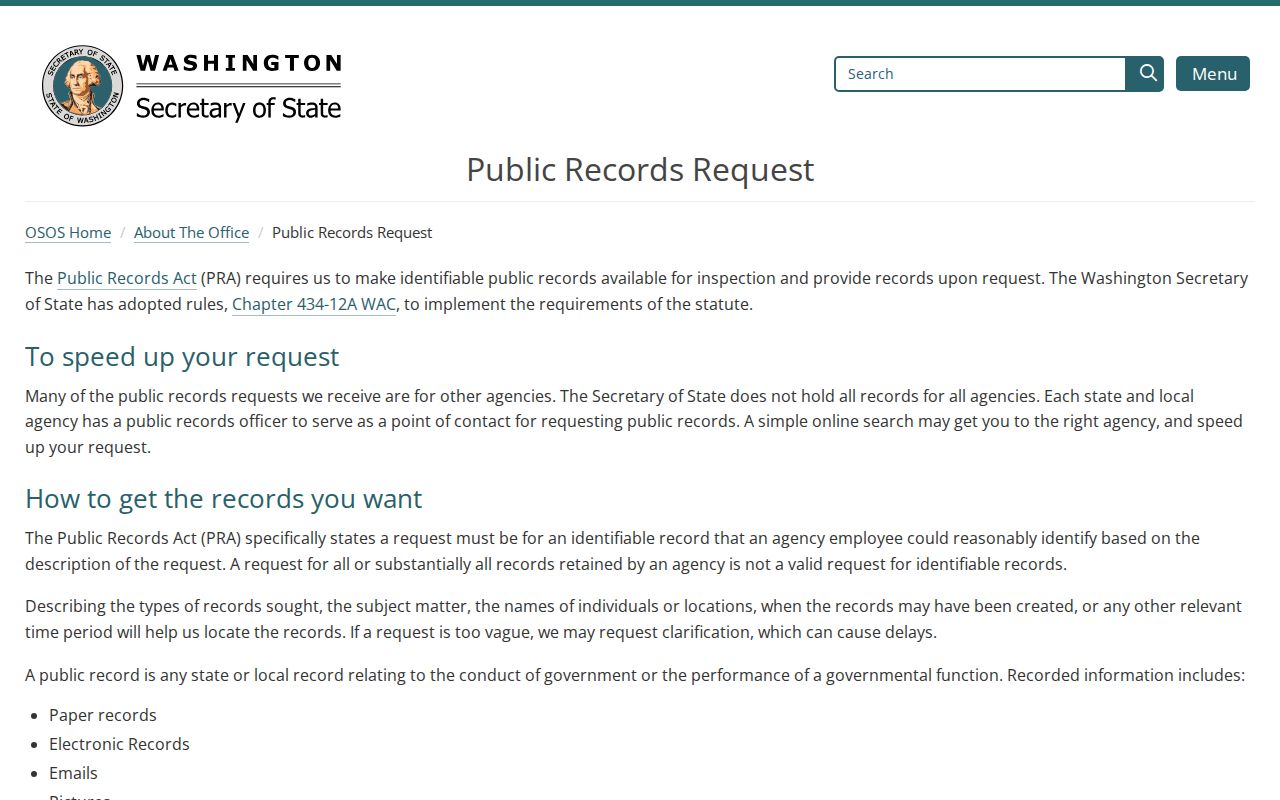
The same core drafting rule applies elsewhere: request known files, not an answer to a broad question, and route county-created material to the county that holds it.
Lawful personal use. Public access never permits stalking, tracking, harassment, intimidation, or harm. Use Washington records for lawful research and confirm sensitive facts with the custodian.
Washington Record Denials and Review
RCW 42.56.550 permits superior-court review in the county where an agency record is kept. The court reviews the matter anew, and the agency bears the burden. A requester who prevails receives costs and reasonable attorney fees, and the court may award up to $100 per day. RCW 42.56.530 also offers optional Attorney General review for a state-agency denial. The Open Government Ombuds provides informal help.
On May 19, 2026, the Attorney General proposed revised, nonbinding PRA model rules. The proposal addresses simple and complex request triage, production of a single specific record with the first response, third-party notice, and closure letters. Existing model rules in chapter 44-14 WAC remain in place during rulemaking. This proposal does not alter the five-business-day response paths written in the statute.
Good request records matter. Save the original wording, timestamps, estimates, clarification replies, installment notices, fee statements, produced files, and exemption explanations. That paper trail helps distinguish a lawful withholding from a search problem or routing mistake.